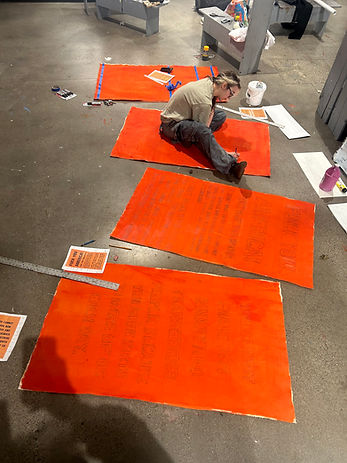
A bit about me...
Jenny Wool is a New-England based multidisciplinary artist exploring the grotesque aspects of nature and everyday life. They spent years studying as a filmmaker and shifted to sculpture while studying at Brandeis University. Jenny’s fascination with color, light, and the horror genre are central to their sculptural work and they are obsessed with creating living, breathing creatures.
They like to tell people that plaster ‘has their heart’ but they enjoy using a myriad of other mediums to create contrast between textures. Jenny started experimenting with gelatin-based bioplastics in 2025 to ethically replicate guts, blood, gums, and other gory subject matter.
Blurring the boundaries between the real and imagined, Jenny’s work focuses on the body – not just the human body, but those of all organic forms. Their work is focused largely on the juxtaposition of beauty and disgust, and how the two can coexist within the body.
AN ARTIST'S MANIFESTO
Learn how to bleed.
It will hurt. But there is so much of that in this world – what’s a little more? Anything can hurt you. Everything can hurt you.
To be an artist is to allow yourself to be hurt unabashedly.
Don’t hide it. Look at the blood without flinching. What runs through your veins? Turn it around for the world to see.
Push at the edges of the wound. Watch the blood pool. Watch it drip down your skin.
Irritate it.
To be an artist is to learn how to scream.
Scream until your voice is raw. Until there’s nothing but a heartbeat pounding faintly between your ears.
To be an artist is to get your hands dirty.
Dig your fingers into the dirt as you scream. Feel the grass break in your fists. The dirt will get under your skin. In your fingernails. It will stain your hands. You will not walk away clean. But you will walk away _____.
To be an artist is to _______.
Take care of your wounds. Don’t let the dirt infect you. Your body is yours.
YOUR body.
YOUR blood.
YOUR wounds.
YOUR hands.
YOUR feet.
YOUR voice.
Use it how you like.
An artist must bleed for their work.
To be human is to bleed.
To be an artist is to know that you bleed more than just blood.
So I ask you – what do you bleed?
My mother was never a religious person. We’d go to church on holidays, and that was about it – except for when there was an animal lying dead in the road. She couldn’t look away fast enough, throwing her hands up in a rushed sign of the cross. She’d mutter about the poor creature and its horrible fate, without ever glancing back at the gross mess. I, on the other hand, would look it straight in the eyes. It was my six-year-old way of attempting to comfort the creature, to say "it’s okay" and "I’m here" and "I see you."
I am fascinated with disgust. In a society that is constantly chasing an unrealistic idea of beauty, it is far too easy to look away from what we deem “ugly.” I want to make the normal feel ugly, and the ugly feel beautiful. I’ve become fascinated with why we’re so horrified in the first place. I am intrigued by death, decay, and the idea of ‘rot’ – specifically, why they have become so taboo, so abhorrent, when they are as natural as the air we breathe.
I seek to capture the visceral feeling of discomfort through the texture I create with my hands. Getting my hands dirty is one of the most important parts of my process, so I often end up prioritizing feeling over proper technique. How can my hands interact with the plaster? How can I use a material to inspire the physical itch to reach out and touch?
I believe that art should inspire raw emotion. Because of this belief, my work became an exploration of what makes us tick — what makes us feel first and think later. I constantly go back to that immediate reaction my mother has when she sees an animal dead on the road. Why does she go back to God? Why can’t she look at what’s in front of her? Why don’t you?